Cargo Theft Incidents Fall in Q1, but Organized Crime and Impersonation Drive New Risks
CargoNet reports fewer supply chain crime events to start 2026. But losses hold steady as organized crime shifts tactics toward impersonation schemes and high-value goods.
According to CargoNet, opportunistic theft cargo may be declining. But more targeted and verifiable crimes are becoming a larger share of criminal activity.
Credit:
CargoNet
3 min to read
Cargo theft and supply chain crime incidents across the U.S. and Canada dipped in the first quarter of 2026. But the threat environment is evolving in ways that should concern fleets and logistics providers.
That’s according to Verisk CargoNet, which just released results from its review of the first quarter of 2026.
Ad Loading...
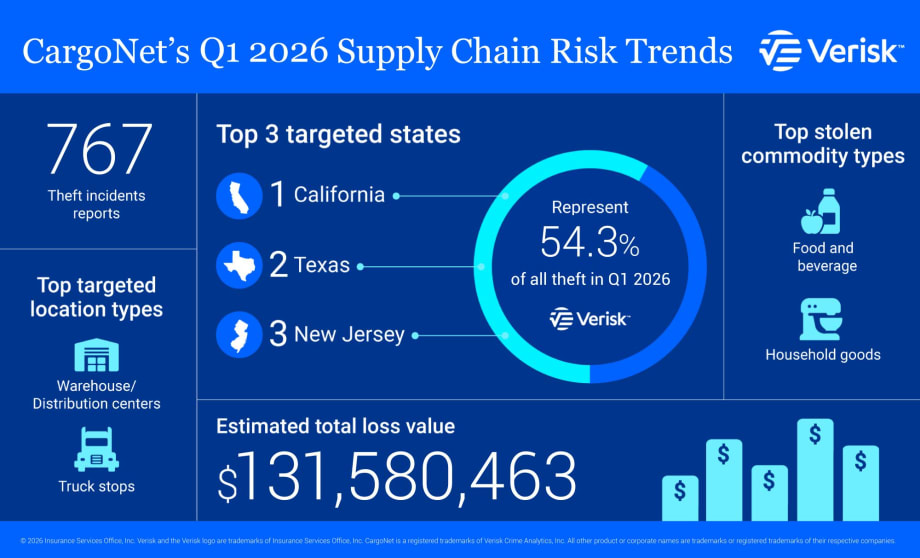
CargoNet recorded 767 supply chain crime events in Q1. The company said that is a 5.3% decrease from the same period a year ago and a 12.2% drop from the previous quarter.
Despite the decline in overall incidents, estimated losses totaled $131.58 million --essentially flat year over year.
At the same time, confirmed cargo theft reports increased, rising by 41 incidents to 596 cases.
Ad Loading...
CargoNet said the data suggests that while opportunistic theft may be declining, more targeted crimes are becoming a larger share of activity.
California and New Jersey stood out as major growth areas. California incidents rose from 255 to 277, while New Jersey more than doubled from 27 to 59 incidents -- a 119% increase. Both states offer dense freight infrastructure and proximity to major consumer markets, making them attractive for organized theft operations.
Meanwhile, traditionally high-activity states tied to opportunistic theft saw declines. Texas, for example, dropped from 102 incidents to 80, particularly in major freight corridors like Dallas–Fort Worth and Houston.
The shift suggests domestic, opportunistic theft activity is giving way to more coordinated operations concentrated in key logistics hubs.
Ad Loading...
Targeted Commodities Replace Opportunistic Hauls
The types of freight being stolen are changing alongside the actors behind the crimes.
Personal care and beauty products saw the sharpest increase, jumping 178% year over year from 18 to 50 incidents, driven largely by cosmetic and fragrance thefts in the Northeast. These products are easy to resell through online marketplaces, making them attractive targets.
Food and beverage remained the top category overall with 144 incidents, though the mix changed. Beverage theft declined while seafood theft rose sharply.
At the same time, traditionally targeted categories such as building materials, apparel, and vehicle-related shipments all declined. These goods tend to be bulkier, less standardized, or harder to quickly resell at scale -- factors that make them less appealing to organized networks.
CargoNet reports that criminal networks are increasingly impersonating legitimate carriers and brokers using two primary methods: credential theft and outright acquisition of trucking companies.
Credential harvesting involves phishing attacks and malware designed to compromise business email accounts, phone systems, and load board or brokerage platforms. Once inside, criminals can pose as legitimate carriers, accept loads, and redirect shipments under trusted identities.
In parallel, some groups are purchasing legitimate motor carriers through online marketplaces and brokerage services. These acquisitions allow criminals to operate under valid authorities, making detection more difficult.
According to CargoNet, the rise in impersonation schemes is partly a response to improved anti-fraud controls at the load tender stage.
“The anti-fraud tools the industry has deployed are working—they’re forcing criminals to invest more in elaborate schemes,” said Keith Lewis, vice president of operations at Verisk CargoNet.
Ad Loading...
However, he warned that focusing solely on tender-stage verification is no longer sufficient. Instead, the industry needs identity verification measures that extend across the full shipment lifecycle, from booking through final delivery.
Outlook: Organized, Tech-Enabled Theft will Persist
CargoNet expects impersonation-based fraud and the exploitation of legitimate carrier identities to remain central to cargo theft activity in the coming quarters.
Organized crime groups are likely to continue focusing on high-value, easily redistributed goods while concentrating operations in major logistics hubs that enable fast movement and resale.
For fleets, brokers, and shippers, the takeaway is clear: fewer theft incidents do not mean lower risk. The threat is becoming more sophisticated and harder to detect.
Heavy Duty Trucking is searching for forward-looking leaders at trucking fleets as nominations for HDT’s Truck Fleet Innovators 2026. Deadline is May 15.
Cargo theft rings plant operatives as drivers inside legitimate, fully vetted carriers, then execute coordinated thefts that look like a traditional straight theft from the outside.
The American Transportation Research Institute will examine driver coaching, regulatory impacts — including the "Beyond Compliance" concept —and weather disruptions that shape trucking operations.
Fleet Advantage's Brian Antonellis says it's time for fleets to get back to the fundamentals of good maintenance practices. And that includes replacing older, inefficient equipment.
Load matching for flatbed, lowbed, oversize and overweight loads can't be automated like basic van freight, but Truckstop.com is adding more high-tech tools to help.
An expanded Trucker Path and Truckstop.com integration brings more freight opportunities into the TruckLoads app while emphasizing security and network quality.
Strong March freight demand combined with a spike in fuel costs pushed both spot and contract truckload rates to their highest levels in more than two years.