




Why Diesel Is Climbing Fast—and What the Iran Conflict Has to Do With It
With global oil flows disrupted, U.S. diesel prices have topped $5 across every region, climbing sharply in the past few weeks.
March 24, 2026


The war in Iran has caused one of the biggest disruptions to energy supplies in history, and U.S. diesel fuel prices are reflecting it.
Credit:
HDT Graphic
2 min to read
The average price of a gallon of diesel fuel across the U.S. hit $5.375 as of March 23, according to Energy Department figures, as the Iran war continues to affect crude oil prices. That’s nearly $1.81 higher than a year ago and 30.4 cents higher than the previous week.
Average prices were over $5 in every region the Energy Information Administration tracks, and $6.87 in California.
The lowest average price was found in the Gulf Coast region, as is typical, at $5.134 per gallon.
In the past month, the average price of diesel has shot up by nearly $1.57, up from $3.809 as reported on February 23.
On-highway diesel fuel started the year at an average of $3.477 per gallon. It had been creeping up slowly until the Trump administration and Israel struck Iran at the end of February.
Why Are Diesel Prices so High?
On February 28, the United States and Israel attacked Iran after weeks of military buildup and threats from President Trump, as the nonpartisan think tank Council on Foreign Relations explains.
Iran effectively blocked the crucial Strait of Hormuz, through which flows about one-fifth (20–25%) of the world's daily oil consumption.
Crude oil prices, traded on the futures market, have been volatile since the strikes, thanks to conflicting reports nearly daily of the status of the war.
Crude oil makes up about 41% of the price of a gallon of diesel as of January figures.
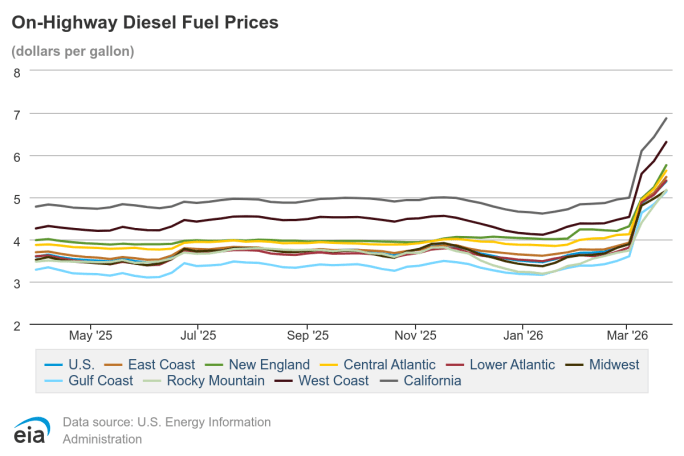
In the past month, the average price of diesel has shot up by nearly $1.57, up from $3.809 as reported on February 23.
Source:
Energy Information Administration
As Reuters reports, the war has caused one of the biggest disruptions to energy supplies in history.
Not only has Iran essentially closed the key Strait of Hormuz shipping route, through which a great deal of the global crude oil supply flows, but also, attacks in the Middle East have damaged production infrastructure in several countries.
The BBC reported that the head of the International Energy warned the war could see the world facing its worst energy crisis in decades.
But Isn’t the U.S. Energy Independent?
Even though the U.S. produces plenty of oil, it’s not shielded from global price swings. Oil is priced on a worldwide market, so when something disrupts supply anywhere, it shows up in U.S. fuel costs.
On top of that, the type of oil produced keeps the U.S. from being self-sufficient.
We export light, sweet crude oil while importing the heavier grades that many U.S. refineries are configured to run. So even as a net exporter, the U.S. is still buying and selling oil at global prices, which keeps diesel and fuel costs tied to global developments.
More Fuel Smarts

Cummins Adjusts 2027 Engine Rollout After EPA Proposal
The engine maker will gradually introduce its new Model Year 2027 diesel engines while continuing to offer current models during the transition, citing the EPA's proposed emissions rule changes.
Read More →
EPA Proposal Could Ease 2027 Truck Costs and Buying Uncertainty
The proposal doesn't change the tougher NOx standard, but it would revise key implementation requirements that manufacturers say have driven up costs and complicated fleet purchasing decisions.
Read More →
Cummins, Paccar Ease DEF Derates After EPA Guidance
Updated diesel engine software gives truck operators more time to address emissions-system issues while staying compliant with EPA emissions standards.
Read More →
Maintenance in the Messy Middle Part 3: Biodiesel
Biodiesel can reduce emissions, improve fuel-system lubricity and use existing diesel infrastructure. But NACFE’s Messy Middle maintenance report says fleets must actively manage storage, cold-weather operation, filters and oil drain intervals to avoid problems.
Read More →
Enhance Fleet Performance with High-Efficiency Auxiliary Power Units
Drive sustainable cost savings while increasing driver comfort during short- and long-haul logistics operations.
Read More →
Maintenance in the ‘Messy Middle’ Part 2: Renewable Diesel Fuel
NACFE's latest Messy Middle Powertrain Service & Maintenance report says renewable diesel gives fleets an opportunity to reduce carbon emissions without changing trucks, fueling infrastructure or maintenance practices. But technicians still need to understand several important operational differences.
Read More →
The Diesel Engine Enters NACFE’s ‘Messy Middle’
NACFE’s new Messy Middle Powertrain Service & Maintenance report says keeping modern diesel engines running now depends as much on software, diagnostics and data as traditional mechanical service.
Read More →
DTNA Software Update Gives Truckers More Time Before DEF Derates Take Effect
The changes reflect EPA guidance aimed at reducing downtime caused by emissions-system faults while maintaining compliance requirements.
Read More →
New Agentic Predictive Maintenance Report Demonstrates How Degraded Aftertreatment Systems Waste Fuel
Questar analyzed a large mixed-class fleet and discovered it was wasting as much as $30 in fuel per vehicle, per day, because of mechanically degraded aftertreatment systems.
Read More →
New York City's Microhub Project is Delivering Results
Trucking, last-mile delivery companies, and environmental advocates like what they are seeing so far with New York's microhub program.
Read More →