





Will FMCSA’s Driver-Oriented Enforcement Initiatives Affect Capacity?
Tight Trucking Capacity Pushes Rates Higher Even as Freight Volumes Fall
“Spot rates moving ahead of contract rates have historically signaled a tightening market, but we haven’t seen a capacity-driven market quite like this one,” said DAT's Dean Croke.
August 12, 2026
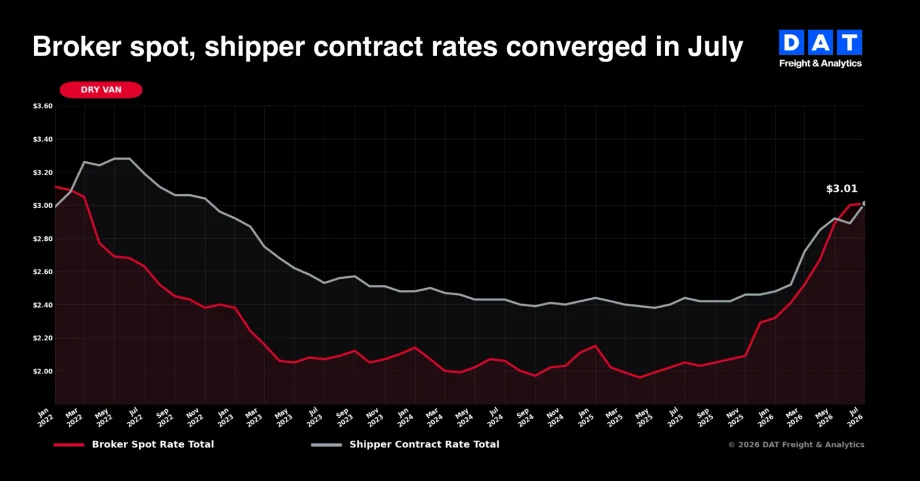
Contract linehaul rates for dry van and refrigerated freight posted their largest June-to-July increases on record, according to DAT.
Credit:
DAT Anslytics
5 min to read
Truck freight volumes may not be particularly strong, but increasingly tight capacity is pushing freight rates higher and creating more favorable conditions for carriers, according to new reports from industry research sources.
FTR’s Trucking Conditions Index remained firmly positive in June at 17.1, down from a record 20.4 in May. Meanwhile, July data from DAT Freight & Analytics showed record June-to-July gains in contract rates for dry van and refrigerated freight — even as freight volumes declined.
The combination points to a freight market where constrained capacity is playing a larger role in rate increases than growing freight demand.
“We expect the market to be favorable for carriers throughout our two-year forecast horizon, but the recovery appears to be stabilizing,” said Avery Vise, FTR vice president of trucking.
FTR said slightly slower freight-rate growth in June was partially offset by lower diesel prices. The firm also strengthened its outlook for carriers compared with its previous forecast.
Vise said much of the truck freight market’s strength so far has come from supply-side constraints, particularly in dry van and refrigerated operations.
Mixed Signals for Coming Months
Nevertheless, there are some encouraging signs on the demand side as well. Manufacturing demand continues to recover, consumer spending has remained solid, and data center construction has provided a particular boost to flatbed freight, according to FTR.
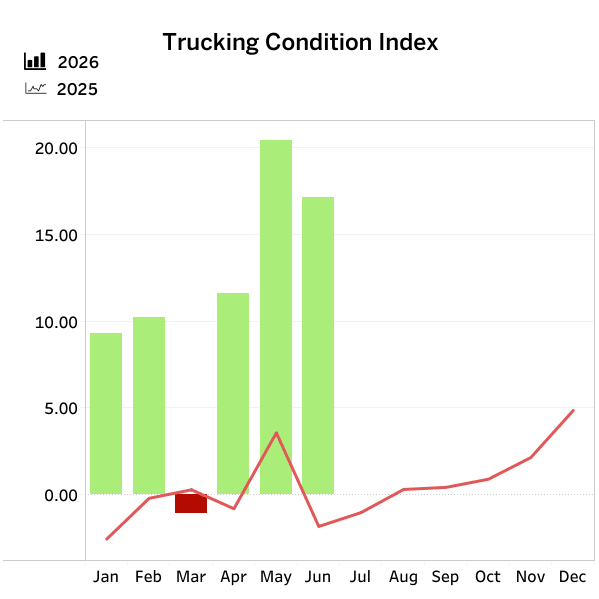
FTR’s Trucking Conditions Index combines five factors affecting the U.S. trucking market: freight volumes, freight rates, fleet capacity, fuel prices, and financing costs.
Credit:
FTR
However, Vise pointed to slowing U.S. job growth, continued weakness in housing, and persistent inflation for both consumers and businesses as concerns.
“Although freight demand still doesn’t look that strong, we see little sign that trucking capacity will rise substantially in the near term,” he said.
Rates Rise as Freight Volumes Fall
DAT’s July data offers more evidence of the growing influence of available capacity on freight rates.
Contract linehaul rates for dry van and refrigerated freight posted their largest June-to-July increases on record, according to DAT. The average dry van contract linehaul rate, excluding fuel, increased 13 cents from June to $2.39 per mile. The reefer rate increased 9 cents to $2.62.
Yet freight volumes declined across dry van, reefer, and flatbed.
DAT’s Truckload Volume Index fell 6% from June for dry van, 5% for reefer, and 8% for flatbed. Compared with July 2025, volumes were down 3% for van, 13% for reefer and 7% for flatbed.
Freight volumes typically decline in July following seasonal activity in June, but the decline in reefer volume was the steepest June-to-July drop in six years, according to DAT.
An Unusual Capacity-Driven Market
Despite those lower volumes, spot rates remained elevated. Excluding fuel, average July spot linehaul rates were $2.39 per mile for dry van, $2.75 for reefer and $2.90 for flatbed.
The dry van figure was particularly notable: National average spot and contract van linehaul rates both reached $2.39 per mile in July.
“Spot rates moving ahead of contract rates have historically signaled a tightening market, but we haven’t seen a capacity-driven market quite like this one,” said Dean Croke, DAT industry analyst.
“Van spot and contract rates reached parity in July even as volumes declined, while van and reefer contract rates posted record June-to-July gains.”
Compared with July 2025, spot linehaul rates were 76 cents per mile higher for van freight, 79 cents higher for reefer and 86 cents higher for flatbed. Contract linehaul rates were up 37 cents for van, 30 cents for reefer, and 49 cents for flatbed.
“When rates rise this quickly as volumes fall, it indicates that available capacity is exerting greater influence on pricing,” Croke said.
FTR also noted some seasonal softening in spot rates in July, even as fuel prices rose sharply. Vise said that was a markedly different dynamic from March.
Even if spot rates have peaked, however, FTR expects contract rates to continue rising well into 2027.
What's Constraining Trucking Capacity?
ACT Research also sees supply constraints as a major force behind improving freight rates.
In its latest North American Commercial Vehicle Outlook, ACT said the tightening initially was driven by a significant contraction in driver supply following four years of trucking overcapacity.
ACT said additional pressure on capacity has come from stricter enforcement of electronic logging device and hours-of-service rules, new carrier registration requirements, and the Supreme Court’s Montgomery decision involving broker liability.
At the same time, ACT sees improvement in some freight-demand fundamentals, including the recovery in U.S. manufacturing and continued data center and utility construction.
New Truck Orders Boost Backlog
Higher freight rates are also helping revive demand for new trucks following several difficult years for carrier profitability.
“Underlining the robustness of the current demand environment has been the backlog-boosting surge in tractor orders that began last December,” said Ken Vieth, ACT president and senior analyst.
In August 2025, tractor order backlogs had fallen to a nearly 13-year low, according to Vieth. By the end of June this year, backlogs had more than doubled from year-ago levels.
Even so, tractor sales remained below replacement levels during the first half of 2026 as truck manufacturers and suppliers worked to bring more production capacity online.
“The rebound in tractor demand follows the four-year drop in profitability that culminated in generationally low carrier profit margins in 2025,” Vieth said.
Capacity Constraints Could Persist
Higher freight rates and driver pay also should eventually help offset some of the industry's supply constraints.
But ACT does not expect those pressures to disappear quickly.
“Many of the capacity constraints will persist and worsen,” Vieth said, describing the industry's supply-side challenges as “extraordinary as we move further into this new upcycle.”
That assessment generally aligns with FTR’s outlook. While freight demand itself remains less than robust, FTR sees little prospect of a substantial increase in trucking capacity in the near term.
More Fleet Management

Nomination Deadline Extended for HDT Emerging Leaders
Just a few more days to nominate accomplished trucking fleet professionals under 40 who are making an impact and helping lead the industry forward for the HDT Emerging Leaders award. Deadline extended to October 20!
Read More →
What Will ATA’s New Leader Bring to Trucking's Table?
Incoming President and CEO Mark Colson’s record in Alabama offers clues about his priorities and approach following Chris Spear’s abrupt departure as the head of the American Trucking Associations.
Read More →
Volvo, Waabi Start Commercial Autonomous Operations in Texas
Volvo VNL Autonomous trucks, powered by the Waabi Driver, are hauling freight directly to third-party facilities for a customer in Texas.
Read More →
Samsara Launches Custom AI Agent Builder
Agent Studio lets fleets create AI tools for hours-of-service monitoring, reporting and driver support, including agents that communicate by phone.
Read More →
Einride Driverless Electric Trucks Begin Daily Freight Operations in Ohio
Two cabless electric trucks are hauling freight between EASE Logistics facilities in Marysville, Ohio, as part of a multi-state truck automation project.
Read More →
Geotab Links Fleet Card to Vehicle Data
The new card combines fuel discounts with telematics-based purchase controls. Geotab’s analysis also points to potential savings from choosing lower-priced fuel stops.
Read More →
How MFA Helps Protect Trucking Fleets
Multi-factor authentication adds protection when passwords are stolen. Here’s how it works and where fleets should start.
Read More →
How Better Freight Data Helps Trucking Teams Get Ahead of Disruption
Trucking and logistics teams have plenty of data. The problem is getting the right information in front of the right people soon enough to act. Better-connected data can help teams spot trouble earlier and make smarter decisions before small problems become big ones.
Read More →
Trimble: Taking Artificial Intelligence in Trucking Beyond Faster Tasks
At Insight 2026, Trimble executives argued that fleets may need to redesign workflows to get more from AI as it introduced new products and enhancements. AI’s value will depend on how fleets combine automation with their people's knowledge.
Read More →
Sponsored•September 28, 2026
Build a bulletproof fleet: Uniting ELDs and dash cams for total compliance
An ELD can prove compliance, but it cannot always prove what happened on the road. Discover how uniting accurate ELD data with AI-powered dash cam video can help your fleet strengthen compliance, defend against liability, protect drivers and reduce operational costs.
Read More →