




Related: Crude Oil, Fuel Prices on the Rise
Fleets Hit 7.28 MPG Average in Latest NACFE Efficiency Report
Fleets are benefiting from increased adoption of the latest fuel-saving technologies, but are still falling short of what is possible, according to a new report from the North American Council For Freight Efficiency.

Steven Martinez・Web Editor
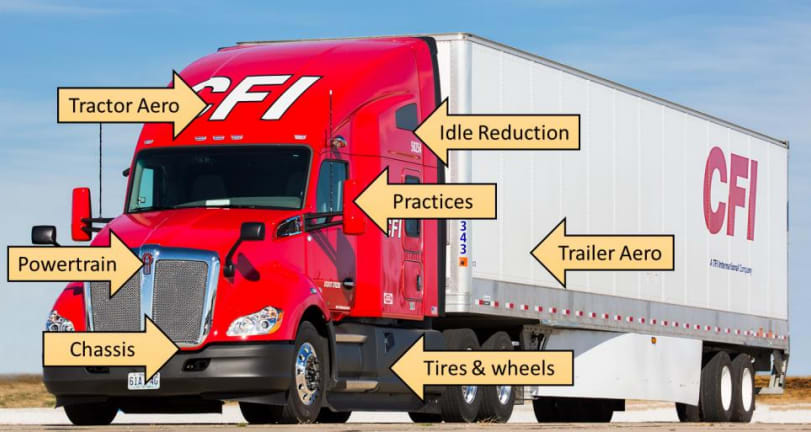
Fleets saw a 2% increase in fuel efficiency in NACFE's latest report thanks to increased adoption of the latest technologies.
Photo via NACFE
3 min to read
Fleets are benefiting from increased adoption of the latest fuel-saving technologies, but are still falling short of what is possible, according to a new report from the North American Council For Freight Efficiency.
In its latest Annual Fleet Fuel Study, NACFE found that the 20 fleets it surveyed posted a 2% increase in fuel economy from the year before, hitting an average of 7.28 mpg over the course of the year. The 20 fleets are a mix of large- and mid-sized fleets representing 72,000 Class 8 trucks in daycab and sleeper configurations.
This is significantly better than the average reported by the Federal Highway Administration’s most recent data for over-the-road tractors, which shows that fleets made up of older equipment have generally stalled at around 5.9 mpg since it began releasing data in 2007.
NACFE also charted a hypothetical “Business as Usual” prediction, charting what the group would expect these same surveyed fleets to achieve if they had not adopted any fuel-saving technology and only benefited from advances in engine efficiency improvements. These fleets were predicted to achieve 6.42 mpg in the same operating environment, nearly a mile per gallon less.
That gap between “Business as Usual” predictions and NACFE’s surveyed fleets offered savings that weren’t anything to sneeze at. The group said it amounts to $5,122 per year per truck at a $2.65 per gallon cost of with an average tractor mileage of 105,041. In total, NACFE projects that this difference accounts for savings of over $600 million compared to the average.
Compared with the FHWA baseline, savings increase to $8,864 per year per truck.
But despite the gains, NACFE still sees a gap between what these fleets could be achieving and what they are actually seeing. Last year, the group organized the Run on Less challenge, in which fleets placed their best drivers in trucks outfitted with the latest fuel-efficient equipment and managed to average 10.1 mpg in real world driving conditions.
While these results were achieved in an operating environment that placed a premium on fuel-efficient driving at all times, NACFE said fleets need to focus on a comprehensive look at what exactly works for their operations. Simply spec'ing the latest equipment won’t necessarily lead to maximum savings and depending on the typical driving applications, some equipment may be more useful than others.
Good drivers were also seen as a way to increase fuel mileage. While trucks are becoming more technologically advanced, with systems that can increase the efficiency of every driver, a good driver will still be able to get the best out of those systems. While experienced drivers in the past may have had a larger effect on fuel efficiency than they do now, a driver is still an extremely important aspect of it.
The full study goes into more detail on the 85 types of fuel-saving equipment used and even tracks what systems have dropped in adoption since 2016. The report is available for free on the NACFE website.
Corrected to indicate NACFE's Run on Less was last year, not earlier this year. We apologize for the error.
More Fuel Smarts
Electric Yard Tractors Move Beyond Pilots
Operating-cost savings have overtaken sustainability goals as the leading reason surveyed fleets are adopting battery-electric terminal tractors, according to new NACFE research.
Read More →
Geotab Links Fleet Card to Vehicle Data
The new card combines fuel discounts with telematics-based purchase controls. Geotab’s analysis also points to potential savings from choosing lower-priced fuel stops.
Read More →
Fleet Economics Shape Electric Truck Outlook
ACT Research expects costs, charging infrastructure, and technology improvements to drive zero-emission commercial vehicle adoption as federal regulations and incentives retreat.
Read More →
Wex Adds Cardless Fuel Payments for Over-the-Road Customers
A new fuel card feature for Wex customers offers convenience and security.
Read More →
New California Law Could Shed Light on Electric Truck Prices
Why do battery-electric Class 8 trucks remain so expensive? A California bill signed by Gov. Gavin Newsom would give fleets and state agencies more visibility into what manufacturers charge.
Read More →
How Volvo Updated Its D13 for EPA 2027 [Watch]
Volvo’s updated D13 promises lower emissions without sacrificing performance or fuel economy. Take a closer look at what changed inside the engine in this HDT Spotlight video.
Read More →
Diesel Price Spike Shortens Payback for Natural Gas Trucks, Report Says
Energy Vision estimates fleets could recover the higher purchase price of an RNG-fueled Class 8 tractor in 1.3 to 2.8 years under current fuel-price scenarios.
Read More →
Calstart Becomes Catalyst Mobility, Reflecting Broader Focus
Calstart is now Catalyst Mobility, reflecting the nonprofit’s growing national role in clean transportation, including zero-emission trucks, infrastructure and incentive programs.
Read More →
Record Diesel Prices Squeeze Trucking Fleets
Average U.S. diesel prices have climbed to nearly $6 a gallon, surpassing the 2022 record as tight refinery capacity and Middle East disruptions keep fuel costs elevated.
Read More →
East Coast Port Launches $45M Electric Truck Push
The Port Authority of New York and New Jersey announced millions in incentives for zero-emission drayage trucks, yard tractors, and new charging hubs near the port.
Read More →