




Cameras in the Cab
Truck fleets are increasingly deploying in-cab video systems as part of their technological arsenal to increase safety and security.

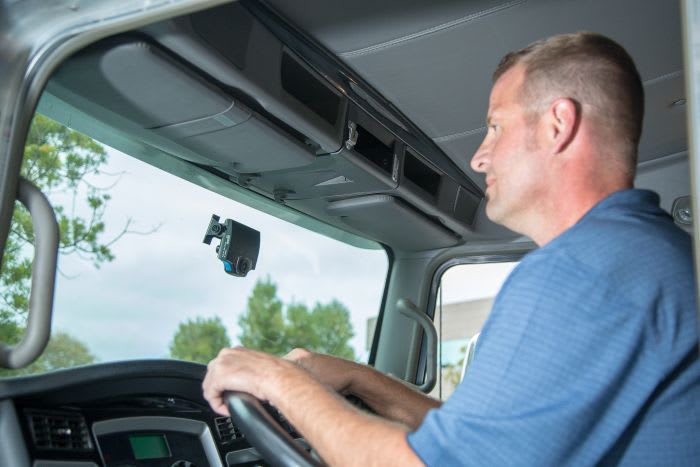
Fleets can see real improvement with in-cab video systems. Photo courtesy of Lytx
Fleets can see real improvement with in-cab video systems. Photo courtesy of Lytx
Truck fleets are increasingly deploying in-cab video systems as part of their technological arsenal to increase safety and security. While these systems do generate some privacy concerns, the bottom line is that fleets are seeing improvements in safety, driver training and other areas.
In many cases, the in-cab video systems join other active safety technologies such as stability control systems, lane departure warning, and reactive cruise-control.
At Melton Truck Lines, Tulsa, Okla., in addition to the in-cab video system from Lytx, the company also equips its trucks with Bendix’s AutoVue lane departure warning system, says Rick Vincent, director of safety and driver training. An in-cab telematics platform tracks lane departure, forward collision warning and hard braking events. Driver trainers and managers use this information to coach the drivers that need it most.
At M&W Logistics, Nashville, Tenn., in addition to the SmartDrive in-cab video system, the fleet also specs Meritor Wabco products including stability control, lane departure and forward collision mitigation systems, according to Mike McFarlin, M&W CEO. “The forward collision mitigation system and the stability control systems are integrated with the SmartDrive camera system,” he explains. “Any time one of these systems activates, the video system captures a 20-second video clip and transmits it to the SmartDrive team for review.”
Both fleets have seen benefits from deploying these systems. McFarlin says M&W experienced a 34% decrease in total accidents within the first year. In addition, Level 3 and Level 4 accidents — the most severe — dropped by more than half. “We have also benefited from the capture of video in certain accidents that exonerated our drivers.”
Vincent noted that in the event of a collision where the camera was triggered, Melton gets “a clear video of the event and we can quickly begin managing the claim and or pursue recovery.” On-site law enforcement reports, witness statements and claimant statements can differ from the driver’s account, he says, and the video “in most cases provides the clear evidence needed.”
How they work
While there are various in-cab video systems available, most work in a similar fashion. The devices typically have a forward lens focused on what is happening outside of the truck and an inside lens that looks at the driver and passenger. The devices also contain an accelerometer that can measure sudden movements such as rapid deceleration or other forces. They record continuously, but only save video if there is an event such as hard braking, sudden deceleration, or an alert from other safety systems. In that case, the devices typically save the video for a certain amount of time before the event (usually 8 to 10 seconds) and for a few seconds after the event.
These recorded events are then uploaded via the cloud to the vendor’s site, where specialists review them. Only videos that show risky driving behavior are sent back to the fleet. For instance, if the video recorder is activated because the truck hit a pothole that shakes the cab, that video would not be sent to the fleet.
In addition to the device’s accelerometer, video can be saved when there are alerts from other safety systems such as collision avoidance or lane departure warning.
In addition, some devices record continuously. Safety Track, Bellevue, Mich., recently introduced a new line of live streaming cameras that allow fleet managers to stream live video while their vehicles are on the road. This system records both the driver and what he sees in front of the truck for up to 40 hours.
Convoy Technologies, Newport Beach, Calif., introduced a system in April that allows users to configure the camera for continuous, event-driven or scheduled recording. It integrates the vehicle’s GPS information with the video. Using a cloud-based system, the videos can be accessed for playback on smartphones, tablets or PCs.
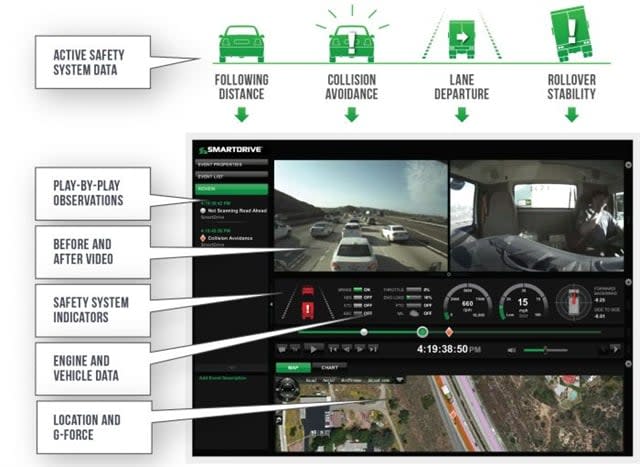
The SmartDrive Systems in-cab video recorder integrates with active safety systems such as those from Wabco to trigger video recording when risky driving behavior is observed.
In-cab video as training tool
One of the more interesting benefits of video systems is their use in coaching and training drivers. Greg Lund, director of corporate communications, Lytx, San Diego, says fleets deploying such systems not only see a reduction in collision-related costs, but they also see “driver behavior improve significantly, and fairly quickly.”
When risky behaviors are noted, the video clips are sent to the fleet, where driver managers can review the clip with the driver and offering coaching on the problem behavior that led to the incident. Conversely, if the video was triggered because the driver had to take evasive action to avoid a collision, he can be recognized for doing a good job.
“Over time, we can look at the drivers — the ones exhibiting behaviors that can be corrected,” Lund explains. “The fleet decides which drivers need to be coached the most and which drivers should be rewarded and which ones are showing improvement.”
Melton’s Vincent notes that managing driver behavior can be a “daunting task, especially in the long-haul environment given the lack of face time with the drivers.” They’ve found that “driving behavior can be positively affected just by the camera being there.”
He explains that fleet safety is essentially managing behavioral hazards and having an in-depth understanding of the factors that influence individual driver decision-making. “Video events allow coaching opportunities not available in the past.”
At M&W, the initial aim when deploying the video system was to “capture video evidence to guide us in the handling of auto liability claims,” McFarlin says. While the system has shown benefits in that area, it “has really become more of a driver training and incentive tool.
“Adding the system to our trucks has allowed us to pinpoint areas where we need to train individual drivers. By working with each driver on habits he or she needs to improve upon, we are becoming a much safer fleet.” M&W has also tied its safety bonus program to a scorecard generated by the system.
M&W’s drivers were leery about cameras in the cab initially. “It was a pretty hard sell to our drivers when we first announced we were adding this system to all of our trucks,” McFarlin says. The drivers were mainly concerned that fleet managers would be “watching their every move like we were watching them on TV.” But drivers came around once they realized the only time video would be saved would be when they did something to trigger the camera. M&W has added a keypad that allows drivers to log out of the system when the truck is parked and the brake engaged.
Vincent says there were some driver concerns at Melton, but found that communicating up front how the system worked, how it triggers and where the video clip ends up was important to driver acceptance. Also helping drivers feel more comfortable were recorded events that helped exonerate the driver and company.
Plus, professional drivers have become more used to the various technologies fleets deploy. “More and more carriers are adopting some form of electronic recording of crashes and events,” Vincent says. “Over time that also will help with overall driver acceptance.”
Lund agrees that how the system is rolled out is important in generating driver acceptance. It’s understandable that drivers might have concerns, he says, but if the fleet does a good job explaining the system is there to help them and in some cases, even exonerate them, it is much easier.
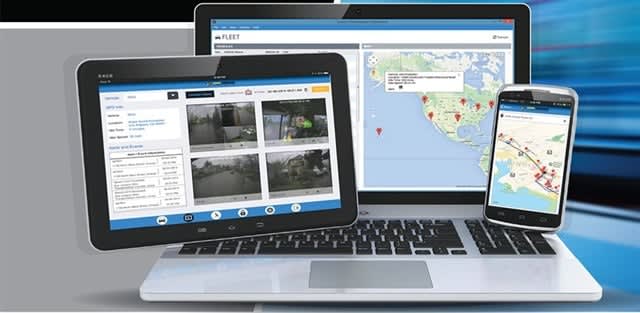
The in-cab video system from Convoy Videomatics can be configured to record continuously, when triggered by an event or at scheduled times.
Finding more uses
Beyond recording events, in-cab video systems can also be used as an analytics tool and for other purposes.
“We are trying to solve more and more problems with video, beyond exonerating or coaching drivers,” says Steve Mitgang, CEO of SmartDrive, San Diego. For instance, the system can integrate with side view cameras. One fleet asked if it could be used to help catch fuel theft. “We’re finding ways to use video beyond front-end crashes,” he adds. Some customers have installed rear-facing cameras on the truck that monitor the flatbed trailer to make sure the load is strapped and tarped correctly.
And the data can be used in analytics as well, says Lytx’s Lund. “Predictive analytics is a big part of what we do.” The systems allow them to track about 100 driver behaviors. “We can predict which drivers are most likely to be in a collision,” he explains. Fleets receive information showing which drivers need coaching, which ones are improving and which ones are doing great, with no recorded events.
In the end, it still comes down to the people driving the truck. Vincent says in-cab technology, especially systems that are intended to mitigate risk and affect driver awareness and behavior, must be kept in perspective and managed properly. “Where we certainly believe in them, we must remain keenly aware that nothing replaces a safe, professional driver behind the wheel.”
More Safety & Compliance
PrePass, Kodiak Connect Driverless Trucks to Roadside Enforcement
The system will allow enforcement agencies to verify Enhanced Inspection information and decide whether Kodiak’s autonomous trucks can bypass roadside screening sites.
Read More →
From One Generation to the Next: How Mentorship Builds Safer Truck Drivers
After three decades in trucking, Harold Perry shares what he's learned about driver safety, mentorship, and helping the next generation build confidence behind the wheel.
Read More →
FMCSA Pauses Biennial-Update Enforcement Amid Motus Transition
Carriers whose updates were due on or after June 1 have more time, while FMCSA works to stabilize its new registration system and warns of phishing sites impersonating its new carrier registration system, Motus.
Read More →
ZF Expands Commercial Vehicle Push in North America
ZF is expanding its North American commercial-vehicle presence with new transmission applications, electrification, trailer technology and autonomous-driving systems.
Read More →
Truck Drivers Need More Than Another Alert
Fleets have more visibility into truck health, safety events, and driver activity than ever. The next challenge is turning all that information into useful guidance for the person who has to decide what to do next.
Read More →
Tesla Wants a Self-Driving Semi. Are Cameras Enough?
Could Tesla’s camera-only autonomous driving technology work on an 80,000-pound Semi? In this commentary, HDT's Deborah Lockridge takes a look at Tesla, Cybercab, and how autonomous trucks see the road.
Read More →
What DOT’s Automated Vehicle Strategy Means for Trucking
The U.S. Department of Transportation issued a new automated-vehicle strategy that outlines plans for driverless-truck regulations, cross-state freight corridors, and federal safety standards.
Read More →
NYC Expands Speed, Pedestrian Safety Tech Across Fleet
New York City is expanding intelligent speed assistance and pedestrian-alert systems across its municipal fleet, moving the technologies from pilot programs into vehicle procurement and retrofit requirements.
Read More →
FMCSA Removes 110 Truck Driver Training Schools from Certified ELDT List
Federal regulators also are targeting more than 160 additional training providers and launching a nationwide audit of third-party CDL skills testers as part of a broader crackdown on trucking fraud.
Read More →
Beyond DOT Compliance: What Makes a Trucking Fleet Truly Safe?
A trucking fleet can follow every rule and still make unsafe decisions. The real test comes when safety conflicts with freight, productivity, or cost.
Read More →